
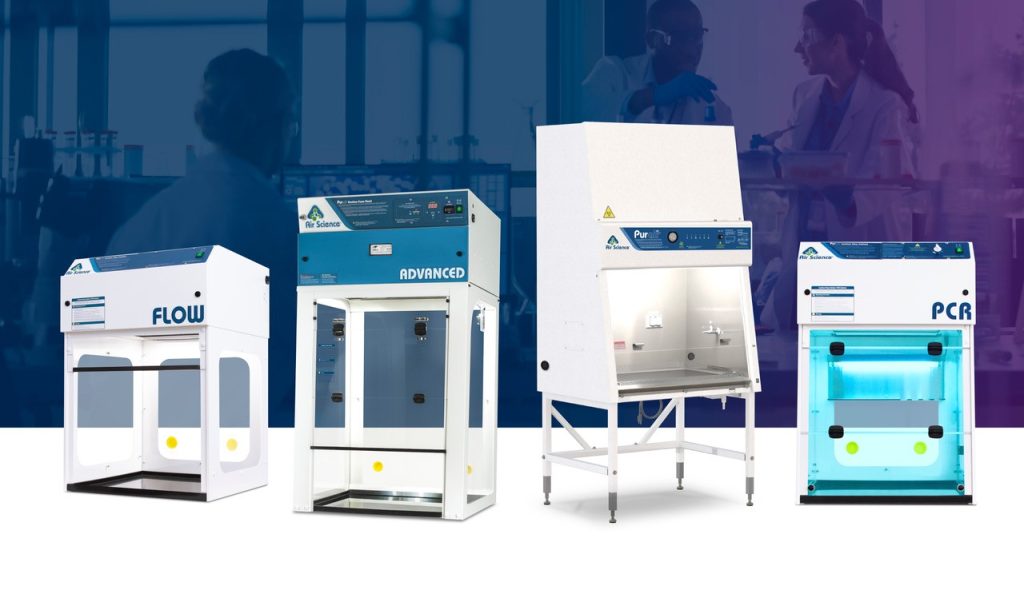
In the modern laboratory, safety and efficiency are requirements. Whether you are establishing a new facility or upgrading an existing workspace, the equipment you choose must align perfectly with both your physical processes and the chemical profiles of your work.
Navigating the intersection of application needs and chemical compatibility is the foundation of a safe lab. This guide breaks down the essential decision-making factors to help you select the right Air Science® solution for your specific environment.
Step 1: Define Your Application Requirements
The first step in equipment selection is identifying the primary threat to your process. Is the hazard coming from the materials you are using, or is your process susceptible to outside contamination?
- Operator Protection: If you are working with hazardous vapors, odors, or non-sterile powders, a Ductless Fume Hood is the standard. These units protect the user by pulling air away from the face and through high-efficiency filtration.
- Product Protection: For applications like electronics assembly or pharmaceutical preparation where the sample must be protected from dust and particulates, a Laminar Flow Cabinet provides an ISO Class 5 sterile environment.
- Dual Protection: In life science or clinical settings where you must protect both the user and a biological sample, a Class II Type A2 Biological Safety Cabinet (BSC) is required.
- Process Specifics: Specialized tasks require specialized geometry. For example, PCR Workstations offer the specific UV sterilization needed for genetic amplification, while Balance Enclosures provide the ultra-smooth, turbulence-free airflow required for high-precision weighing.
Step 2: The Chemical and Filtration Factor
Once you understand the airflow requirements, you must evaluate the chemicals in use. Unlike ducted hoods that simply vent fumes outside, ductless systems rely on the science of adsorption.
The Molecular Rule of Thumb
Generally, chemicals with a molecular weight over 30 and a boiling point higher than 60°C are excellent candidates for carbon filtration. However, the type of carbon matters.
Air Science utilizes the Multiplex™ Filtration System, which uses the following to create a combination of chemical and physical architecture customized to each application:
- The Pre-Filter: An electrostatic prefilter that traps larger particulates to extend the life of the main filters.
- The Main Filter: This is the primary chemical or particulate barrier. Depending on your needs, this can be a HEPA/ULPA filter or one of our 14+ specialized carbon formulations.
- The Optional Safety Filter: For high-risk applications, a second carbon or HEPA filter can be added to provide a final layer of protection and prevent breakthrough.
Consult our SEFA Chemical Compatibility Guide to ensure your specific chemical family is compatible with ductless technology.
Step 3: Ductless vs. Ducted – Which is Right for You?
While ductless technology offers incredible flexibility and energy savings, the decision often comes down to volume and variety.
- Choose Ductless if: You need portability, want to avoid expensive HVAC renovations, or operate in a space where external venting is physically impossible. Ductless hoods are highly effective for most laboratory-scale chemical volumes.
- Choose Ducted if: You are working with extremely high volumes of volatile chemicals, constant evaporation, or complex chemical cocktails that may exceed the saturation capacity of a standard carbon filter. Our Total Exhaust™ ducted hoods provide a robust solution for these high-demand scenarios.
Step 4: Maintenance and Long-Term Performance
Choosing the right equipment is only half the battle; maintaining it ensures continued safety. Consider the Total Cost of Ownership, including:
- Filter Monitoring: Look for units with integrated airflow alarms and electronic saturation sensors to take the guesswork out of filter changes.
- Accessibility: Ensure your chosen unit allows for easy filter replacement without specialized tools.
- Compliance: Verify that your equipment meets national and international standards for your specific industry.
The Air Science Advantage
At Air Science, we understand that every lab is unique. Our Laboratory Desk Reference and Filtration Guides are designed to help you cross-reference your chemicals with the right enclosure.
Ready to find your perfect match? Contact our technical team today for a personalized application assessment, or browse our full range of solutions at Ductless.com.