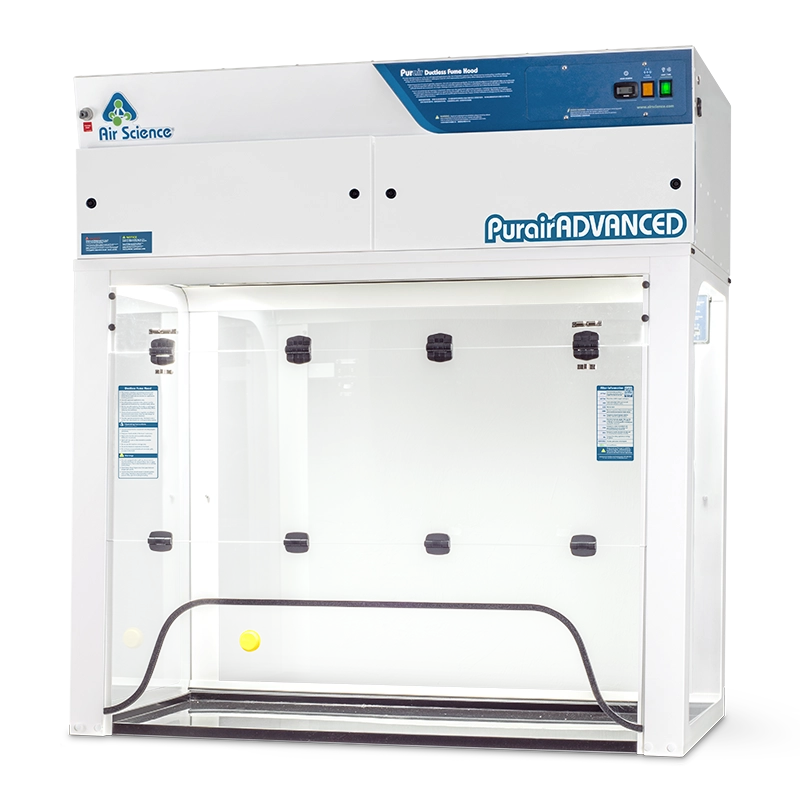
High-Performance Ductless Containment for Demanding Laboratory Applications
Purair® ADVANCED is a robust, high-performance ductless fume hood designed for laboratories that need greater working space, high-capacity filtration, and flexible configuration options. Available in seven standard sizes, the oversized enclosure provides ample room for larger equipment and processes, while application-specific filtration helps protect users from compatible hazardous vapors, fumes, and particulates.
OSHA Standard -29 CFR, Safety and Health Regulations for General Industry, 1910.1450: Occupational exposure to hazardous chemicals in laboratories. Part B, definition, laboratory type hood. Please consult your Safety Officer and/or Industrial Hygienist.
OSHA Standard -29 CFR, Safety and Health Regulations for General Industry, 1910.1450: Occupational exposure to hazardous chemicals in laboratories. Part B, definition, laboratory type hood. Please consult your Safety Officer and/or Industrial Hygienist.
OSHA Standard -29 CFR, Safety and Health Regulations for General Industry, 1910.1450: Occupational exposure to hazardous chemicals in laboratories. Part B, definition, laboratory type hood. Please consult your Safety Officer and/or Industrial Hygienist.
OSHA Standard -29 CFR, Safety and Health Regulations for General Industry, 1910.1450: Occupational exposure to hazardous chemicals in laboratories. Part B, definition, laboratory type hood. Please consult your Safety Officer and/or Industrial Hygienist.
OSHA Standard -29 CFR, Safety and Health Regulations for General Industry, 1910.1450: Occupational exposure to hazardous chemicals in laboratories. Part B, definition, laboratory type hood. Please consult your Safety Officer and/or Industrial Hygienist.
OSHA Standard -29 CFR, Safety and Health Regulations for General Industry, 1910.1450: Occupational exposure to hazardous chemicals in laboratories. Part B, definition, laboratory type hood. Please consult your Safety Officer and/or Industrial Hygienist.
OSHA Standard -29 CFR, Safety and Health Regulations for General Industry, 1910.1450: Occupational exposure to hazardous chemicals in laboratories. Part B, definition, laboratory type hood. Please consult your Safety Officer and/or Industrial Hygienist.
Why Choose the Purair® ADVANCED Ductless Fume Hood?
Designed for more demanding laboratory applications, Purair® ADVANCED combines an oversized work enclosure with high-capacity, application-specific filtration and flexible configuration options. Seven standard sizes provide room for a wide range of equipment and processes, while clear side and rear panels provide excellent visibility throughout the work area.
More Working Space
A 38-inch internal working height provides room for larger equipment and processes.
Flexible Filtration
Activated carbon and HEPA/ULPA filtration options allow the system to be configured for different laboratory hazards.
More Size Options
Seven standard widths from 30 to 96 inches accommodate applications ranging from smaller work areas to large laboratory equipment.
IMPORTANT
Ductless fume hood suitability is application-specific. Chemical type, concentration, quantity, evaporation rate, frequency and duration of use, filter media, and operating conditions should be evaluated before selecting a ductless fume hood and filter configuration.
38″ internal working height for larger equipment and processes.
High-Capacity Filtration
Designed for more demanding laboratory applications.
More Size Options
Seven standard sizes from 30″ to 96″ wide.
Compare Standard Ductless Fume Hoods
Ductless Fume Hoods
Purair® FUMEBOX
Purair® BASIC
Purair®ADVANCED
Downflow Workstations
EDU Series with
Mobile Base
Available External Width
20.72 - 29.75"
24 - 48"
29.5 - 96"
24 - 48"
24 - 59.5"
Available External Height
15.67 - 21.16"
35"
53"
31.5"
78 - 87"
Available External Depth
12.02 - 24.72"
24 - 27"
27.375"
22.75"
27 - 28.5"
Available Internal Height
11 - 20.63"
23.6"
38"
15.75"
24 - 38"
Description
Fume Adsorber
Compact, Value
Premium, High Performance
Unique Downward Airflow
Educational, Demonstration
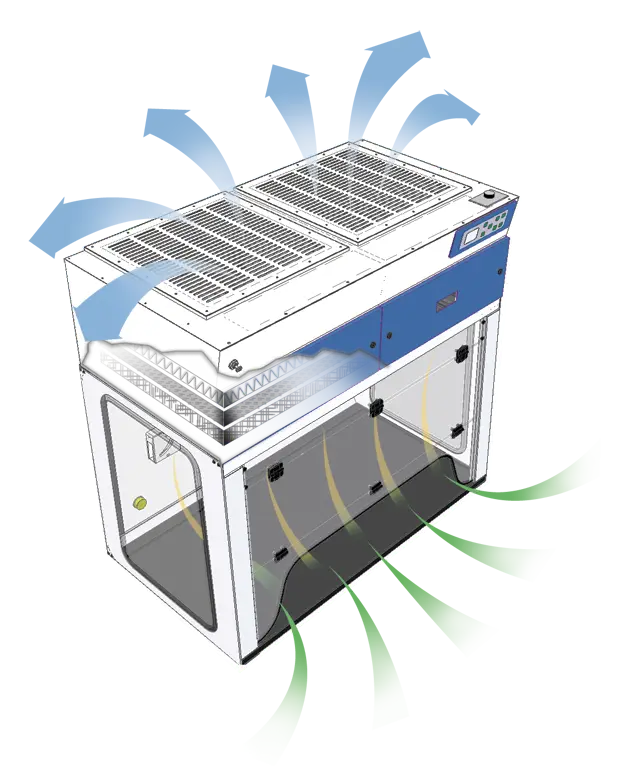
How Does a Purair® ADVANCED Ductless Fume Hood Work?
Room air is drawn inward through the hood opening to help contain contaminants generated within the enclosure. The contaminated air passes upward through the Air Science Multiplex™ Filtration System, where filtration is selected for the specific application. Filtered air can then be returned to the laboratory in normal ductless operation.
How Does Multiplex™ Filtration Technology Work?
At the heart of the Purair® ADVANCED is the Multiplex™ Filtration System. It uses a pre-filter, a primary activated carbon or HEPA/ULPA filter, and an optional secondary/safety activated carbon or HEPA/ULPA filter. The system can combine filter media and configurations to address chemical vapors, powders, particulates, biological aerosols, or mixed applications.
Unlike a one-filter-fits-all approach, Multiplex™ can use a single activated carbon filter, specialty carbon, blended or stacked carbon filters, HEPA/ULPA filtration, or combinations of carbon and particulate filtration. Filter selection should be based on the actual chemicals and hazards used in the application.
Purair® ADVANCED can be configured with filtration selected for the specific hazards of your application. Activated carbon filters are available for compatible chemical vapors, while HEPA/ULPA filtration can be used for powders and particulates.
The most widely used filter in the range, primarily for solvent, organic and alcohol removal.
ACI Plus!/SUL
Designed to neutralize volatile inorganic acid vapors.
ACM
Mercury vapor
AMM
Removes vapors from dilute ammonia solutions and to remove low molecular weight amines.
FOR
Designed to oxidize formaldehyde and glutaraldehyde fumes; It is widely used in hospital pathology laboratories.
HEPA/UPLA
Powders and particulates.
EFT™
Universal filtration for a broad range of core chemical families
Frequently Asked Questions
Below are answers to our frequently asked questions and links to additional helpful information.
What chemicals can be used in a Purair® ADVANCED ductless fume hood?
The Purair® ADVANCED ductless fume hood can be configured with application-specific activated carbon filtration for compatible chemical vapors. Suitability depends on the chemical, concentration, quantity, temperature, evaporation rate, frequency and duration of use. Complete the Air Science chemical compatibility form for application review.
Can the Purair® ADVANCED use HEPA or ULPA filtration?
Yes. Current Purair® ADVANCED ductless fume hood specifications include HEPA/ULPA filtration for particulate applications. Activated carbon and particulate filters perform different functions and should be selected according to the hazards generated by the process.
Does a Purair® ADVANCED ductless fume hood require external ductwork?
No. In normal ductless operation, contaminated air passes through the selected filtration system and filtered air is returned to the laboratory rather than exhausted through building ductwork.
Can the Purair® ADVANCED be used for solvents?
Many solvent applications may be candidates for a Purair® ADVANCED ductless fume hood when the solvent and expected vapor loading are compatible with the selected activated carbon media. The specific solvent and operating conditions should be evaluated before selection.
Can the Purair® ADVANCED be used for acids?
Certain acid applications may be appropriate with filtration selected for compatible inorganic acid vapors. The specific acid, concentration, quantity and operating conditions should be reviewed before selecting a filter configuration.
Can the Purair® ADVANCED handle formaldehyde?
Air Science lists a dedicated FOR filter formulation for formaldehyde and glutaraldehyde fumes. A general-purpose carbon filter should not automatically be assumed suitable; the application should be reviewed for concentration and loading.
How Often Should Ductless Fume Hood Filters Be Replaced?
There is no single replacement interval for every ductless fume hood filter. Filter life depends on the type of filter, the chemicals or particulates being captured, their concentration and quantity, frequency and duration of use, evaporation rate, particulate loading, and other operating conditions.
Activated carbon filters should be monitored based on chemical usage and filter loading and replaced before their adsorption capacity is exhausted. HEPA and ULPA filters should be monitored for loading and airflow performance and replaced when they no longer provide the required airflow or filtration performance, or according to the laboratory’s established maintenance and validation procedures.
Air Science recommends establishing a filter monitoring and replacement program appropriate to the specific application rather than replacing filters based on time alone. A filter that looks clean may still require replacement, and activated carbon can become saturated without a visible change; filter condition should not be determined by appearance alone.
Can a Purair® ADVANCED Ductless Fume Hood Be Connected to External Ductwork?
Optional duct collars can be added for applications requiring external exhaust. Depending on the selected configuration and application, the system may be used in ductless filtration mode, connected to external exhaust, or configured to combine filtration with venting. Air Science should review the proposed airflow, filtration and exhaust arrangement before selection.
How Should Used Activated Carbon Filters Be Disposed Of?
Used activated carbon filters should be disposed of based on the chemicals and contaminants they have captured. A filter that has adsorbed hazardous chemicals may need to be managed as hazardous waste or according to other applicable federal, state, local, and facility requirements.
Do not assume a used carbon filter can be disposed of as ordinary trash. Review the chemicals used in the hood and consult your facility’s Environmental Health & Safety (EHS) or waste-management personnel for the appropriate disposal method.
How Should Used HEPA or ULPA Filters Be Disposed Of?
Used HEPA and ULPA filters should be disposed of according to the materials and contaminants collected by the filter. Filters used only for nonhazardous particulates may have different disposal requirements than filters exposed to hazardous, toxic, biological, pharmaceutical, or other regulated materials.
The filter’s contamination history should determine how it is handled and disposed of. Consult your facility’s EHS or waste-management personnel and follow applicable federal, state, local, and facility requirements.
Can I Use a Bunsen Burner in a Purair® ADVANCED Ductless Fume Hood?
Open flames, including Bunsen burners, are not recommended whenever they can be avoided. An open flame introduces an additional fire hazard and can affect airflow within a fume hood. Where an application requires an open flame, the process should be reviewed by the laboratory’s safety professional and Air Science before use.
Is the Purair® ADVANCED Ductless Fume Hood Fire Rated?
No. The Purair® ADVANCED ductless fume hood should not be represented as a fire-rated fume hood or fire-containment system. Air Science’s published fire testing demonstrates how the metal support structure performed under the specific controlled test conditions, but the testing should not be interpreted as a fire-rating certification.
Not Sure Which Ductless Fume Hood or Filter You Need?
Air Science can review your application, chemicals, concentrations, quantities, and process requirements to help determine an appropriate ductless fume hood and filtration configuration.