
The landscape of forensic science is evolving at an unprecedented pace. As the discipline moves forward, the focus is increasingly shifting toward more accurate differentiation of samples (power of discrimination), whether that is identifying a specific suspect’s DNA, a unique chemical compound, or a specific type of microscopic diatom. Simultaneously, forensics aims to improve the speed and sensitivity of analytical methods while maintaining rigorous standards for evidence integrity and personnel safety. According to recent reviews of the field’s trajectory, the future of forensic science relies heavily on the integration of advanced molecular tools and the standardization of laboratory environments to handle increasingly complex and challenging samples.i
For forensic professionals and law enforcement personnel, this evolution brings both new capabilities and new challenges. From the crime scene to the courtroom, the chain of custody and the purity of evidence are paramount. Achieving accurate, repeatable results requires not only highly trained personnel but also specialized equipment designed to mitigate contamination risks and protect those handling unknown or potentially hazardous materials.
The Critical Role of Contamination Control in DNA Analysis
Over the last three decades, forensic genetics has witnessed significant advancements, evolving from early blood typing to the current gold standard of short tandem repeat (STR) analysis and massively parallel sequencing (MPS).ii These techniques allow investigators to develop DNA profiles from minute or severely degraded samples. However, the extreme sensitivity of Polymerase Chain Reaction (PCR) amplification makes it highly vulnerable to trace amounts of foreign DNA. In high-stakes investigations, any cross-contamination can lead to false positives, reduced power of discrimination, and compromised evidence.
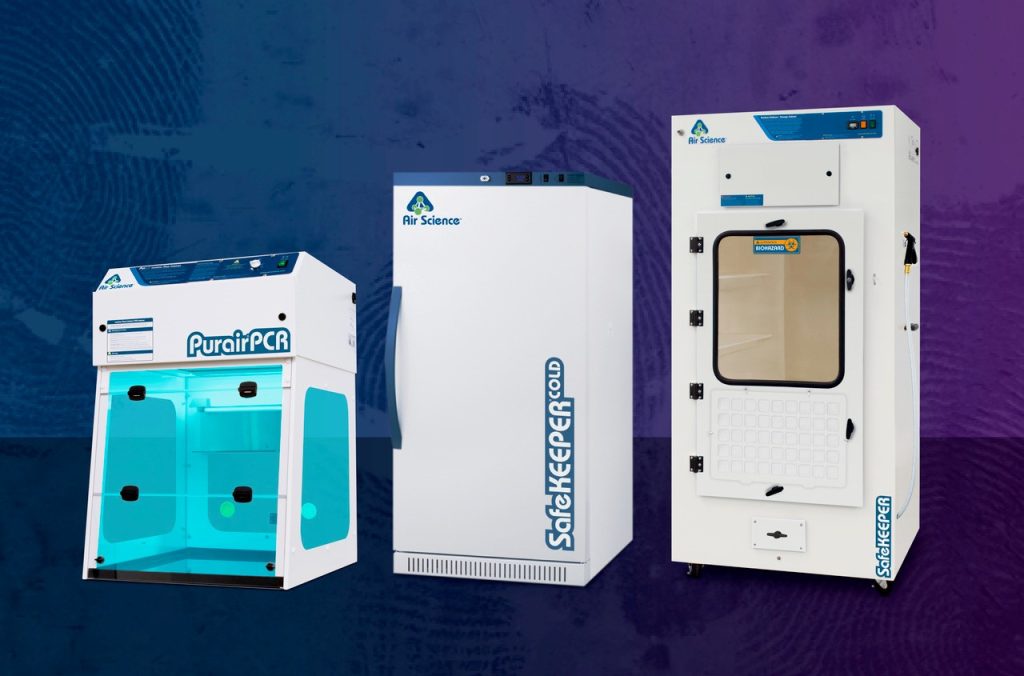
To combat this, forensic laboratories rely on vertical laminar flow enclosures, commonly known as PCR cabinets or workstations. These specialized environments use HEPA/ULPA filtration to provide a constant flow of purified air over the work surface, creating a sterile zone for amplification procedures. Equipment like the Air Science Purair® PCR Workstation is engineered specifically for these sensitive applications, providing a secure barrier against ambient contaminants while offering flexible access to thermocyclers.
Preserving Evidence Integrity: Drying and Cold Storage
The chain of custody begins long before evidence reaches the bench. When biological evidence is collected from a remote crime scene, it must be protected from chemical and biological degradation. Forensic evidence drying cabinets offer a controlled, tamper-resistant environment that provides cost-effective storage and containment for forensic evidence as it is dried. By utilizing a constant flow of air for drying and ductless technology to capture airborne pathogens, particulates, and odors emitted by the contents, these cabinets allow evidence to dry safely. Many units are configured for mobile use to meet needs from the field to the lab.
Temperature-sensitive biological materials must be protected from moisture, excessive heat, and sunlight. For evidence that requires cold storage to maintain its integrity prior to processing, standard household or shared refrigerators are insufficient for maintaining the strict security and uniform conditions required for forensic work. Instead, specialized forensic science refrigerators are required to preserve temperature-sensitive evidence while maintaining the chain of custody. Purpose-built evidence refrigerators, like the SafeKEEPER® COLD, feature individually locking compartments to prevent commingling and ensure that the chain of custody remains unbroken during storage.
Advancements in Fingerprint Processing and Personnel Safety
While DNA analysis often dominates headlines, fingerprinting remains a cornerstone of forensic identification. However, the processes used to develop latent prints carry inherent risks. Forensic industry literature and NIOSH guidelines highlight that fingerprint dusting powders, which often contain a blend of rosin, carbon black, ferric oxide, and heavy metals, can pose significant health and safety risks to evidence processing personnel when inhaled.iii
To mitigate these risks, fingerprint dusting is best managed in a negative-pressure environment that uses downward airflow to protect operators from fume and particulate hazards. When equipped with a HEPA/ULPA filter cartridge, downflow workstations capture fine particulates sourced from the brush during the dusting process.
For 2nd and 3rd level print detection, cyanoacrylate (CNA) fuming chambers provide a safe alternative to conventional dusting. These chambers safely develop latent fingerprints using CNA vapor in a highly controlled environment, allowing technicians to precisely manage critical variables like moisture and fuming time without exposing themselves to toxic fumes. Similarly, specialized development chambers accelerate the processing of prints on porous surfaces using chemical developers like Ninhydrin and DFO.
Emerging Disciplines: Forensic Diatomology
As forensic science expands, new disciplines are emerging that require specialized environmental controls. Forensic diatomology, the examination of microscopic algae (diatoms) to determine causes of death, particularly in cases involving aquatic environments, is a rapidly advancing field.iv This microscopic analysis requires pristine conditions to prevent environmental diatoms from contaminating the sample. Ductless microscope enclosures provide a particulate-free environment that can protect delicate samples from contamination or the user from any chemical preparations used during slide mounting.
Prioritizing Narcotics Safety for First Responders
Beyond the laboratory, first responders and law enforcement personnel face ever-present dangers in the field, particularly concerning the handling of unknown narcotics. The prevalence of synthetic opioids and fentanyl presents a severe risk, as these substances can be lethal even in microscopic amounts.
While physical skin contact is a common exposure route, the inhalation of powder or residue poses the most significant risk for adverse effects. When suspected narcotics are present, immediate steps must be taken to prevent exposure. In addition to personal protective equipment, specialized containment solutions, such as ductless fume hoods and powder weighing enclosures, are critical for the safe handling, testing, and packaging of these hazardous substances once they are brought into the facility.
Conclusion
As forensic science continues to advance, the equipment used to process and store evidence must keep pace. Maintaining a safe, contamination-free environment is essential for achieving the accurate, reproducible results that the justice system demands. By integrating advanced filtration, ergonomic design, and strict security features, specialized forensic equipment protects both the integrity of the evidence and the health of the professionals dedicated to solving crimes.
From field processing to transport, storage, and laboratory analytical procedures, Air Science provides the forensic products needed to meet the rigorous demands of each step in the evidentiary chain. Explore our full line of forensic equipment today.
i Ross, Alastair, Chris Lennard, and Claude Roux. “Forensic Science: Where to from Here?” Forensic Science International 366 (2025): 112285. https://doi.org/10.1016/j.forsciint.2024.112285.
ii Alketbi, Salem K. “The role of DNA in forensic science: A comprehensive review.” International Journal of Science and Research Archive 9, no. 2 (2023): 814–829. https://doi.org/10.30574/ijsra.2023.9.2.0624.
iii Centers for Disease Control and Prevention, “National Institute for Occupational Safety and Health (NIOSH),” https://www.cdc.gov/niosh/index.html.
iv Soni, Anamika, et al. “A comprehensive review of forensic diatomology: contemporary developments and future trajectories.” Egyptian Journal of Forensic Sciences 14, no. 1 (2024). https://doi.org/10.1186/s41935-023-00378-7.