Filtration Safety & Compliance
To ensure safe operation and properly maintain your ductless fume hood, you must replace the filters on a regular basis and check your chemical handling and compliance with the requirements of current safety standards routinely. A failure to check chemical handling or replace filters regularly can result in the recirculation of harmful vapors into the air.
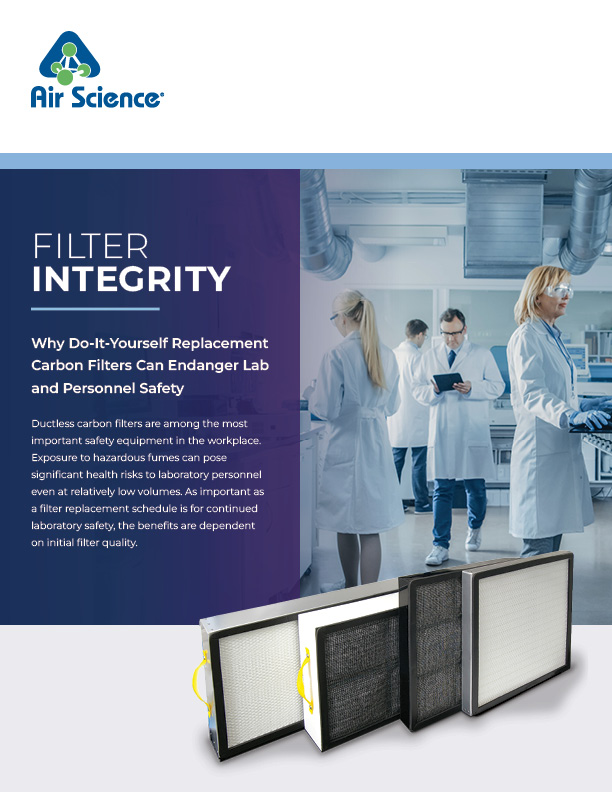
While regular filter replacement is an essential first step, using high-quality replacement filters is equally important. Cheap or low-quality filters may seem like a cost-effective option, but they can pose significant risks to personnel safety and compromise the integrity of your laboratory environment.
A single gram of activated carbon, usually made from a wide variety of carbon-rich raw materials, including wood, coal, peat, coconut shells, nutshells, bones, and fruit stones, is chemically prepared in a process called “activation” to achieve an extraordinarily large microscopic surface area. The carbon is treated to attain the proper porosity and aggregate surface area required to react with the aerosolized chemicals moved through the filter.
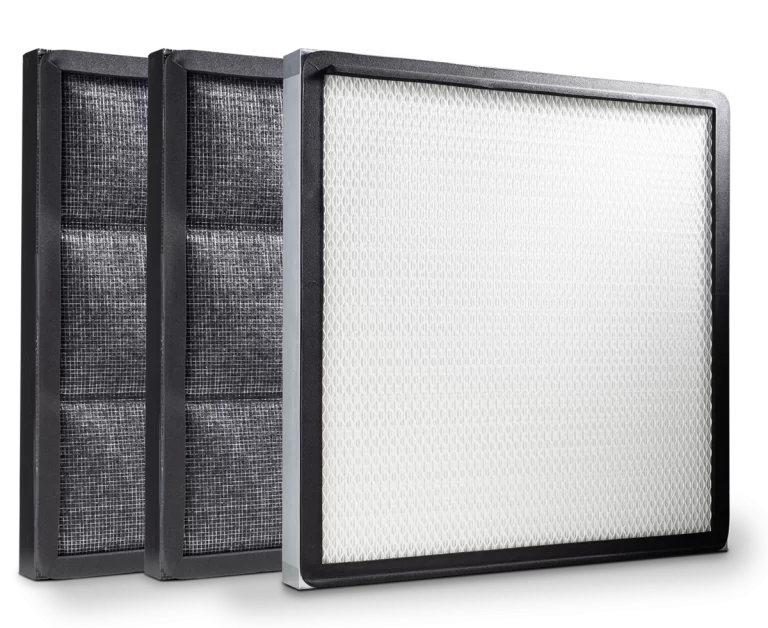
For activated carbon filters, even carbon distribution throughout the filter is essential for consistent performance. Some manufacturers use inferior carbon packing or inferior materials, like common charcoal, that are not chemically prepared to trap specific chemical vapors, potentially exposing lab personnel to hazardous substances. High-quality filters employ durable mesh outside the filter frame that helps maintain the integrity of the carbon bed to prevent carbon shifting that can occur during transportation or handling, compromising the filter’s effectiveness and reducing its lifespan.
The filtration is based on adsorption, which includes two main processes: physical adsorption and chemisorption37. Physical adsorption uses Van Der Waals’ forces to attract and capture gas molecules as they diffuse into the carbon’s pores38383838. The carbon’s large aggregate surface area (up to $2000 \text{ m}^2/\text{g}$) provides vast space for this to occur39393939. This physical process is often followed by chemisorption, which is a chemical reaction where the two substances react and the resulting chemical is permanently trapped40. Impregnation of the filter media can be used to greatly extend the range of gases that can be removed41.
The filtration is based on adsorption, which includes two main processes: physical adsorption and chemisorption37. Physical adsorption uses Van Der Waals’ forces to attract and capture gas molecules as they diffuse into the carbon’s pores38383838. The carbon’s large aggregate surface area (up to $2000 \text{ m}^2/\text{g}$) provides vast space for this to occur39393939. This physical process is often followed by chemisorption, which is a chemical reaction where the two substances react and the resulting chemical is permanently trapped40. Impregnation of the filter media can be used to greatly extend the range of gases that can be removed41.
The active filter zone is the dark, saturated area within the filter bed where adsorption takes place. As the filter is used, this zone progressively moves up the filter bed. When the active zone reaches the top surface, the contaminant vapor will experience an initial breakthrough, meaning a small percentage of the contaminant gas begins to escape filtration. Filter monitoring is aimed at detecting this initial breakthrough to ensure the operator is warned well before the Permissible Exposure Level (PEL) is reached.
The capacity, or the amount of chemical (in grams or ml) capable of being retained, can be pre-determined by your supplier46. This prediction is made using data from the carbon supplier, testing under dynamic conditions, extrapolation from available data, and engineering judgment. Generally, chemicals with a molecular weight over 30 and a boiling point higher than 60°C are better candidates for adsorption, though exceptions exist.
Yes, activated carbon filters are not recommended for use in several situations:
- Where very large quantities of contaminants are produced, such as during acid digestions or the evaporation of solvents to dryness.
- When very highly toxic substances are in use.
- When unknown reactions are being carried out.
Residence time is the amount of time the air spends in contact with the carbon filter as it crosses the filter. This is the duration during which gas molecules can be adsorbed into the carbon pores before exiting. To maximize adsorption, the residence time should be as long as possible. This is achieved by having sufficient filter thickness and keeping the airspeed crossing the filter to a minimum. However, the airspeed across the fume hood’s face (face velocity) must still be kept at a rate that ensures containment of the fumes within the enclosure.
To learn about factors that determine replacement intervals for all laboratory filters, check out our blog post for comprehensive details: How Often Should You Replace Laboratory Filters
No. While all HEPA filters are designed to capture 99.97% of particles as small as 0.3 microns, construction and quality are crucial considerations.
Filtco’s high-performance filters are constructed using a mini-pleat design that eliminates aluminum separators to increase efficiency, minimize the chance of leakage, and prolong filter life. They also feature a lightweight aluminum frame and a “pour-in-place” silicone gasket for a superior seal.
HEPA and ULPA filters are not designed to remove odors or chemical vapors; they are specialized for capturing solid particulates. These filters use mechanical means to trap tiny particles like dust, pollen, mold, and bacteria. To remove odors, fumes, and solvent vapors, you must use activated carbon filters, which capture chemicals through a process called adsorption.
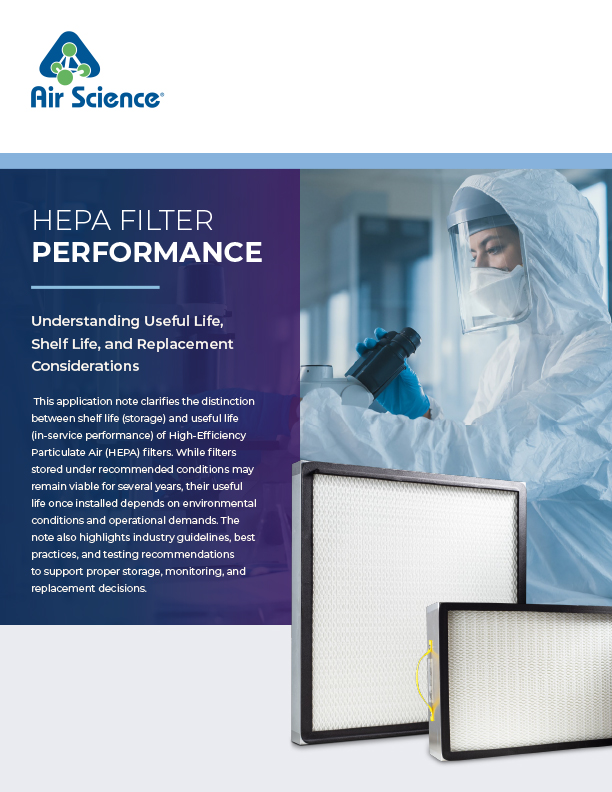
Shelf Life refers to how long an unused HEPA/ULPA filter remains viable when stored properly. Useful Life, however, is the period a filter remains effective once it is installed and in service.
For a more detailed explanation of factors affecting filter lifespan, download our App Note: HEPA Filter Performance App Note.
Beyond the recommended changeout interval, the only other way to determine filter state is to have the unit airflow and leak tested. Learn more about determining the useful life of HEPA/ULPA filters in our App Note: HEPA Filter Performance App Note.